Reliance Industries was the top gainer in the Sensex pack, rising over 1 per cent, followed by M&M, HCL Tech, Axis Bank, ICICI Bank and HUL. On the other hand, Bharti Airtel, Maruti, SBI, PowerGrid, NTPC and Tata Steel were among the laggards.

As markets complete the first half of the calendar year 2022 (CY22) with a fall of around 9 per cent, the interest-rate hike trajectory by global central banks, paired with the conundrum of inflation and growth, will move the needle for the market, observe experts. Here's a quick rundown on what they'll react to over the next six months.

Of the 854 stocks that quoted less than Rs 20 on March 23, 2020 - when the Sensex hit more than a three-year low - 482 have doubled.

'Overtightening of monetary policy by central banks and the spread of new Covid variants, which may force governments to restart lockdowns or restrict mobility.'

Experts say Biyani will now become a contract manufacturer of fashion and FMCG products, with the Reliance group being one of his customers.

Risk-averse investors can hold up to 10 per cent of their portfolio in gold, while aggressive ones can keep five per cent.

Gautam Adani, India's and Asia's second-richest person, added $49 billion to his wealth last year - more than the net addition of wealth by the top three global billionaires Elon Musk, Jeff Bezos and Bernard Arnault, the 2022 M3M Hurun Global Rich List said on Wednesday. Mukesh Ambani, who runs the oil-to-retail conglomerate Reliance Industries, continues to be the richest Indian with a wealth of $103 billion, a 24 per cent rise year-on-year. Adani, the head of ports-to-energy conglomerate Adani Group, is a close second with his wealth surging 153 per cent to $81 billion.

India's GDP may turn positive at 1.3 per cent in the third quarter of 2020-21, having witnessed contraction in the previous two quarters due to the coronavirus pandemic, as the number of cases is falling and public spending has started rising, according to a report. The government will release the GDP numbers for the October-December quarter of the current fiscal on Friday. Projecting that the gross domestic product (GDP) may have returned to the black in the last quarter of the calendar year 2020, DBS Bank in the report said the full-year growth in real terms may be at a negative 6.8 per cent.

The weakness in the rupee and broader markets has led to evaporation in the market cap.

The primary market is set for a bumper Rs 80,000-crore bonanza with 30 companies already filing IPO papers to raise Rs 55,000 crore, while around 10 more are lined up for this month itself, seeking to mop up another Rs 25,000 crore, say investment bankers. The market has been on a non-stop rally, hitting new records almost every week, on the back of an influx of investors -- a vast majority of them first-timers -- coupled with a flood of liquidity. Foreign funds alone had pumped in a record $35 billion into the market in FY21, while the trend has continued this fiscal as well. Domestic institutions led by LIC have also infused trillions of rupees, helping woo retail investors in troves -- the year saw over 20 million new investors coming to the market.

This is despite the private sector companies outperforming their public sector counterparts, reports Sachin P Mampatta.

'The pride of the devoted Seinfeld fan is that he happens to love a show that doesn't take his love for granted, so that even on repeat viewings he is never really sure what directions an episode might take,' observes Sreehari Nair.

Lenders can now initiate recovery proceedings since the SC has lifted the standstill on asset classification, which protected stressed accounts from slipping into NPAs.

After eight months of consecutive outflows, equity mutual funds witnessed a net inflow of Rs 9,115 crore in March amid correction in the stock market. Barring multi-cap and value fund categories, all the equity schemes saw inflow last month, data from the Association of Mutual Funds in India (Amfi) showed on Thursday. However, investors pulled out Rs 52,528 crore from debt mutual funds last month, after investing Rs 1,735 crore in February, owing to advance tax payments and other year ending commitments. Overall, the mutual fund industry witnessed a net outflow of Rs 29,745 crore across all segments during the period under review, compared with a net inflow of Rs 4,090 crore in February.

Titan was the top gainer in the Sensex pack, rising around 4 per cent, followed by HDFC, Nestle India, IndusInd Bank, UltraTech Cement and Bharti Airtel. On the other hand, Bajaj Auto, Tata Steel and NTPC were the laggards.

Auto, pharma, IT, chemicals among sectors with significant reliance on UK and European nations with Tata Motors, Motherson Sumi, Tata Steel, TCS, Wipro, Infosys and Tech M among key names.

Despite the recent fall, the Nifty Midcap 100 index has outperformed by gaining 20 per cent till date in this year calendar year.
Despite the recent fall, the Nifty Midcap 100 index has outperformed by gaining 20 per cent till date in this year calendar year.

HCL Tech was the top gainer in the Sensex pack, rising over 4 per cent, followed by HDFC Bank, Infosys, NTPC, Nestle India, TCS and HUL. NSE Nifty surged 337.80 points to 14,845.10.

If you are a retail investor, you can allocate a portion of the portfolio to the medium- to long-term debt fund category instead of gilt funds.

IndusInd Bank was the top gainer in the Sensex pack, rising around 2 per cent, followed by Axis Bank, HDFC, ICICI Bank, HDFC Bank, Kotak Bank and SBI. On the other hand, ONGC, Tech Mahindra, NTPC, Sun Pharma and TCS were among the laggards.

Portfolio returns, say analysts at Morgan Stanley, are more likely to be driven by bottom-up stock-picking rather than top-down macro forces.

The lockdown in Maharashtra will have a catastrophic impact on April sales, as dealers will not be able to realise the potential of festivities like Ugadi, Gudi Padwa, Baisakhi and Poila Boishakh.

Low home loan rates by banks could put large players in an advantageous position over smaller non-bank players, believe analysts.

The current valuation is 38 per cent higher than the 10-year average of 22x and over 50 per cent higher than the 20-year average of around 20x.

'Earlier-than-expected tapering from the US, followed by rate hikes, and locally, a potential third wave, which mimics the second wave in terms of severity.'

Though the markets have lost ground since the past few sessions, analysts do not seem worried.

Shares of small-cap companies have been on a roll with the S&P BSE Small-Cap index hitting a new high in intra-day deals on Thursday. The rally has been fueled by an up move in stocks of chemicals, cement, graphite electrode makers, pharmaceuticals and information technology (IT) shares. In the past two weeks, since March 25, the index has outperformed the market by gaining 7.3 per cent. In comparison, the S&P BSE Midcap index was up 6.1 per cent, while the S&P BSE Sensex gained 3.6 per cent during the same period.
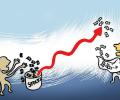
Small stocks made a dashing comeback in 2020 after delivering negative returns in the last two years as increased retail investor participation in pandemic times saw small-cap index surging up to 31 per cent and outperforming the bigger benchmark gauge. This year turned out to be eventful for the equity market, witnessing bearish and bullish sentiments at different points of time. While the initial part of COVID-ravaged 2020 saw the bears in full force amid concerns related to the pandemic and lockdowns hurting economic activities, bulls made a comeback towards the latter half of the year. As the market swayed with many lows as well as highs, small and mid-cap indices emerged as markets favourites in 2020.

For automakers, the festive season is about raking it in through ramped up sales and attractive consumer offers. However, despite the robust demand, what may spoil the party this year is a global shortage of semiconductors.

Tata Motors aims to address 95% of passenger vehicle market by 2020

Acquisitions may have played a role in much of the increase.

ONGC was the top loser in the Sensex pack, followed by HCL Tech, SBI, ICICI Bank, IndusInd Bank, Hero MotoCorp and M&M.

In the coming weeks, online retailers are expected to further raise the pitch with shopping festivals, discounts, and cashback offers.

'Imagine taking care of a patient who is infected with Covid. A human nurse is unable to do that due to fear of infection. The robot can do that task, while it is controlled or supervised by the human nurse. So the robot becomes an extension of the nurse.'

Waves of foreign portfolio investments worth over Rs 51,000 crore splashed into the Indian market in 2021 as overseas investors turned net buyers of domestic securities for the third straight year while excess global liquidity and other factors steered the ebb and flow of their investing ways. With the global financial system still flush with liquidity, emerging market assets, especially equities, might well remain the preferred investment avenue for many more months to come, experts opined. As the equities sizzled during most of 2021, that also saw economy slowly coming back into the recovery path, Foreign Portfolio Investors (FPIs) turned net buyers but their investment is much less compared to net inflows of Rs 1.03 lakh crore in 2020.

As regards India, FIIs have pumped in over Rs 34,400 crore in the Indian stocks in calendar year 2021.

Analysts attribute the surge to a host of factors, particularly the interest shown by the retail investors in these two market segments.

Mid- and small-cap indices have outperformed the frontline benchmarks - the S&P BSE Sensex (up around 10 per cent) and the Nifty50 (13 per cent) - in the first half of calendar year 2021 (H1-CY21) by rallying 26 per cent and 39 per cent, respectively. The trend, analysts believe, is likely to continue in H2-CY21 as well. The outperformance in H1-CY21 comes on the back of improved earnings and strong inflows from the foreign portfolio investors (FPIs) in Indian equities. However, good monsoon so far, gradual opening up of the economy and the pick-up in the pace of vaccination provides support to the market.

Whether it is protecting its turf in its core utility vehicle segment through new model launches, or stepping up investment in electric vehicles, the Anand Mahindra-led firm is leaving nothing to chance
 © 2026 Rediff.com - Advertise with us - Disclaimer - Privacy Policy - Sitemap - Feedback - About us - Terms of use - Grievances